Showing posts with label Books. Show all posts

Thursday, 2 January 2025

2024 Reading in Review


I already posted this on substack, but I like to have this on my own personal blog as well so I'm double-posting it! 


This year, I read more books than I have in many years, blowing my goal of 45 books out of the water with a whopping 63. Of these, only 13 were rereads, which is an unusually low number for me, as I am a chronic re-reader. However good those books may be, (and they were great- Mansfield Park, The Odyssey, The Aeneid, The Hobbit, The Silver Chair, The House at Pooh Corner, etc), I never consider these for my top 5 list of the year, since I don’t want my lists to cycle through the same books every time. 


This year was mystery novel heavy, as I read 14 different mysteries this year, mostly following along with the Close Reads podcast list, plus a few others thrown in. I love mysteries, and I loved having a short and easy book every month to break up the big books I read. While I am not choosing any of them for my top five, I am going to give you a ranking of those at the bottom of the article. It was also a year heavy in homeschool reads (as every year will likely be for the foreseeable future). Highlights in this category were D’Aulaire’s Book of Norse Myths, Jennie Hall’s Viking Tales, and Rosemary Sutcliffe’s retellings of the Iliad and the Odyssey. I also loved reading Nicky Raven’s Beowulf and Emma Sterne’s King Arthur. Sharing these classic myths and legends with my daughter has truly been our favorite part of school. 


A few other honorable mentions before we get into the official top 5: The Road by Cormac McCarthy was haunting and dark but so good and so beautiful. I’ve thought about that book many times since closing it. The Many Assassinations of Samir, the Seller of Dreams by Daniel Nayeri was a delightful and fun children’s story with a perfect opening line (“The first time I was stoned to death by an angry mob, I was not even a criminal.”) Finally, I wrote an entire article about Mrs. Palfrey at the Claremont already, but suffice it to say that it only missed the top five by a hair’s breadth. I have thought about that book weekly ever since reading it, which you’ll keep hearing me say because it is something I love in a good book. Which brings us to the top 5:


  • The Abolition of Man by C. S. Lewis. It feels laughable that I had never read this before, but yet it felt like I had because of just how much other Lewis I’ve read and loved. This is the non-fiction counterpart to one of my favorite novels ever, That Hideous Strength, and I think it’s a must read for anyone interested in education or modernity (and you should be interested in both!) I especially loved the debunking of debunking and the famous discussion of ‘men without chests.’ He reminds those of us involved in education of any kind that the goal of education is to teach a child to love things as they ought. “The little human animal will not at first have the right responses. It must be trained to feel pleasure, liking, disgust, and hatred at those things which really are pleasant, likable, disgusting, and hateful.”


  • The Anxious Generation by Jonathan Haidt. If it seems like everyone is reading this book right now, that’s because everyone should read this book. This book describes the mental health crisis young people are dealing with today, shows how it is a direct result of the rewiring of childhood from play-based to phone-based, and describes what we can do about it. This book is written from an evolutionary worldview, which gets a little tiring at times. However, I think it is such an important book, dealing with topics that everyone needs to consider and come to terms with, that I am wholeheartedly recommending it despite the atheistic worldview. Smart phones, social media, and safetyism are making us worse, and there are things we can do about it. Seriously, go out and buy this book today, read through it, mark it up, and talk about it. You won’t regret it. I read this with one of my bookclubs, and we got hours and hours of great discussion out of it. 


  • A Canticle for Leibowitz by Walter M. Miller Jr. A post-apocalypse story about monks told in three parts? I was frankly not expecting this book to have the impact on me that it did. This was the first book I finished in 2024 and it has haunted me ever since. I loved seeing the church play a prominent role in a post-post-apocalpyitc story for once, and found it both full of despair and full of hope. There are so many heavy, difficult questions brought up in this book, and some very interesting answers given and suggested. While I do think there are some flaws to it, I can’t possibly leave it off my list when it has stayed with me all twelve months of the year. My reading list features heavily the tension between scientific progress and humanity/spirituality, and this book fits right in with that conversation.


  • Crossing to Safety by Wallace Stegner. I read this novel at the recommendation and loan of a friend while I was in the hazy newborn days in bed. It was a perfect read. It tells the story of two couples and their friendship together, in a beautiful and melancholy story. You might say nothing much happens in the story, just as you might say nothing much happens in a Jane Austen story, but only if you miss entirely what it is actually about. I thought this book was a profound and beautiful meditation on friendship and literature and art and place. The descriptions of the land were breathtaking, the characters were wonderfully drawn, and the relationships between them were painfully, sweetly true, without ever lapsing into the realm of the saccharine. I bought it for myself immediately, and I can’t wait to read it again. 


  • Kristin Lavransdatter by Sigrid Undset. Of course this was going to be my number one read of the year. I spent so much time on this book, both in reading its 900-some pages and in thinking about it constantly. I was so engrossed and taken in to this story. I was frequently on the edge of my seat, begging the characters to make good decisions, and reading between my fingers to see what would happen next. This book reminded me of reading Anna Karenina, in that both books had a chokehold on me despite being intimidating long classics. I talked about it so much, and needed to talk about it more, so I convinced my husband to read it this year also. I adore this book. The world building of medieval Norway is immaculate. The characters are so human and so real. I loved following Kristin for good or for ill through her life story, and I am seriously tempted to read it all again already now. There is so much to say and think about regarding this book, that I truly think I could read it a hundred times and never reach the end of what it has to offer. 


If you are a mystery novel lover as well, here is my ranking of the 14 (mostly) new to me reads of the year:

Top tier:

The Mirror Cracked from Side to Side by Agatha Christie

Ordeal by Innocence by Agatha Christie

The Franchise Affair by Josephine Tey

The Chill by Ross Macdonald

Hercule Poirot’s Christmas by Agatha Christie

Mid tier:

The Mysterious Affair at Styles by Agatha Christie

The Case of the Gilded Fly by Edmund Crispin

Jumping Jenny by Anthony Berkeley

Post after Post-Mortem by E.C.R. Lorac

Bottom tier:

Strong Poison by Dorothy Sayers

Death of Jezebel by Christianna Brand

Father Brown: The Essential Tales by G. K. Chesterton

The Maltese Falcon by Dashiell Hammett

The Maid by Nita Prose


My goals for the new year? I hope to read 60 books again, including my staple of at least one Tolkien, Lewis, Austen and Education book. I’m going to attempt to finally tackle and finish War and Peace by reading a chapter a day (I’ve failed to get into this book at least three times, but maybe this approach will work). As usual, I plan to read along with the Close Reads podcast again, keep up with my other book clubs, and fit in some reads on my own TBR as well. 

Friday, 16 February 2024

Top Reads of 2023

 I had high hopes of getting a post out about my 2023 reading highlights at the beginning of the month, but with my computer deciding it needed a few hundred dollars worth of repairs before being workable, we are continuing with the trends of the past few years and posting my reading year in review at the end of January beginning of February instead. Better late than never, right?

I love reading end of the year reviews of favorite books. As late December and early January roll around, the articles and podcasts start coming in, and my TBR list grows dramatically. Because I love reading the lists, I also enjoy making them myself. I've been mentally writing mine for weeks now, and finally have the chance to put it down in writing. So, without further ado, here's quite possibly the latest 2023 review post you'll read. 

I read a total of 47 books last year, of which 16 were books I had read before (some not since childhood!) I started out the year with Jane Austen's Persuasion, a book I read for the first time only three years ago but have already read three times. My last book of the year was also a reread: Milne's Winnie the Pooh. In truth, I probably heard that book a good five times through and bits and pieces of it many many more times, because it is my kids' favorite audiobook at the moment. That's okay though, I consider it to be the very best in children's literature, right up there with the Chronicles of Narnia. Unlike many children's chapter books, it can stand up to being played on repeat, and it's so fun to hear the children going around singing Pooh's hums.

When thinking about my top five reads in a year, I never include the rereads as possibilities since that would make the lists pretty sterile and same (I'm always rereading favorite books). That being said, there were a few rereads that deserve a mention. At the end of the year I finished my second read of the Iliad with my classics book club and it was unbelievably good. It's hard for a book you already love to improve so much, but this one really did. What made it especially memorable was reading Sutcliffe's Black Ships Before Troy aloud to Gwen at the same time, and thus thinking about it nearly constantly and getting to have so many fun conversations about it with her, with book club, and with anyone else who would listen. This year I also read the first three Narnia books to the kids, and it was such fun to introduce them to the stories and see them experience the whole thing for the first time. And speaking of C. S. Lewis, I also reread the Space Trilogy with the Close Reads podcast, which was absolutely a highlight of the year, and Mere Christianity with cousin book club, which provided us with hours of great discussion every week. Finally, I also reread the Silmarillion this year, after not having read it in quite some time, and I was amazed at how moving and powerful and just so good it was. The Silmarillion always gets a bad rap for being hard and long and dry, but I am here to say that it is being undersold by this. It's much better to think of it as mythic, something that will require more attention than a novel, but will be no harder to read than Homer or other myths, and no less powerful. I unashamedly love it.

This brings us to the 30 new books of the year. A few of these were good, but not terribly memorable (e.g. Elantris, The Scarlet Letter), a few I didn't like at all, (e.g. The Last of the Really Great Whangdoodles, The Netanyahus), and many just lay somewhere in the middle, being good but not good enough to make the running for the top spot. But I did have a few that vied for the top and didn't make it, and so I'll start with those honorable mentions:

The Great Passion by James Runcie. This is a fictional story of a young boy in the chorus at St. Thomaskirche under the great J. S. Bach. There was a lot of sadness in this book, and a lot of beauty, and the depictions of the Bach family were just beautiful. The thing that held it back from me were the portions that were heavy on theology but didn't feel true to Lutheranism. If you aren't Lutheran and you aren't as familiar with Lutheran theology, this might not bother you, but with all of Bach's work being so tied to Lutheranism, this really stuck out to me and held it back from being a full five star read. Nevertheless, this book is appearing on the Close Reads roster for 2024 and I'll definitely be rereading it eagerly. 

The Daughter of Time by Josephine Fey. This was such a riveting and interesting mystery, despite it being about a detective on bedrest who simply is trying to solve a mystery about King Richard III from reading historical accounts. Sounds boring, but was actually so interesting and so well done, and I went down a big King Richard rabbit hole after reading this. 

The Liberal Arts Tradition by Kevin Clark, Ravi Scott Jain. This was the best of the education books I read this year and it almost made the top five. It had so many rich and practical thoughts on Classical education, especially on math and science which tend to get the short end of the stick in Classical ed discussions. For those who want to dig in deep into the world of Classical education, this would be a great place to start (and much easier than Norms and Nobility).

A few more quick mentions: One Day in the Life of Ivan Denisovich was so well written and so good, despite being about absolutely horrible circumstances. Galbraith's latest installment in the Cormoran Strike series, The Running Grave, was, I think, her second best to date, and was unputdownable. Ashlee Gadd's Create Anyway was a helpful and inspiring read for me, a mom of many littles who wants to keep up with all her creative work but also struggles with lots of questions like "why bother?" and "how do I even fit this in?"

That brings us, finally, to my top 5 reads of 2023. 

The Sinking City by Christine Cohen. This is a new book, written for younger audiences, but it was so well crafted that it stuck in my head for months. It's been almost a year since I read it, and I still remember vividly some of the scenes, and how great of a reading experience it was. It takes place in Venice, and getting to visit Venice myself not long after reading this surely increased my appreciation for the book, but even if you've never been to Venice yourself, let this book take you on a trip there. It's got magic, mystery, high stakes, great characters, and a perfect setting. You are missing out if you don't read it.

Mistborn by Brandon Sanderson. This was the year that Nick read most of the available Brandon Sanderson books, and he has been eager for me to share in them also. This was the first one I read, and I really loved it. It had such a heist-movie type feel to it, while also being in a well developed fantasy world with a lot of dystopian overtones (and a few fairy tale themes as well). The meshing of all these genres was so unexpected and fun for me, and the characters were really well drawn. I really loved reading this one, and while in my estimation the other two in the series don't quite live up to this first one, I would still definitely recommend it as a fun read when you have some free time for binge reading (it's pretty hard to put this one down).

Love What Lasts by Joshua Gibbs. I am a big fan of Joshua Gibbs' writing, even where I disagree with it. It's provocative and counter-cultural and sure to rile you up while also make you rethink your own assumptions. This was an excellent book about a topic I think about all the time, namely what makes some art better than other art? Is beauty objective or subjective? Can your personal taste be good or bad? Is beauty worth the cost? This book provides some compelling answers to these questions, and challenges you that the things that you like that are easy to like may not actually be good for your soul. As someone involved in making art, enjoying art, and participating in art, I know I'll be returning to this book many times in the future. 

Don Quixote by Miguel Cervantes. When we started this book in my classics book club, we had no idea that we would all come to absolutely love it. It was so funny! It was so thought provoking! It was such a good story! I was thinking about this book for months (a good sign). It cynically looked at the modern world, while also poking constant fun at the old romantic world. It raised questions about sanity, madness, history, myth, morality, virtue, fiction, and even the value of reading books. All of this while being such a surprisingly easy (and did I mention hilarious) read. I can't wait to get back to this one and discuss it again.

Everything Sad is Untrue by Daniel Nayeri. I came late to this book, after hearing it recommended by many people for a few years. I read it with the Close Reads podcast, and while I expected to like it after hearing such rave reviews, it turns out I wasn't at all prepared for it. First of all, this is a deeply sad story. About halfway through the book I wasn't even sure I was gonna make it through. And yet there were also some parts that made me laugh out loud. The turn in the second half of the book was so powerful and made the book breathtaking and redeemed all the sad and hard parts. There's not a lot you can say about the book without giving it away, the unfolding of the story is part of the perfect experience of the book, so I will just leave you with this exhortation: if you read one of the books in my top five this year, it should be this one. I think it's a book that all readers will enjoy.

Tuesday, 24 January 2023

Favorite Reads of 2022

 January's almost over but that doesn't mean I'm not still thinking about the books I read last year, and eager to talk about them.  I set my reading goal as 50 books, and I was down to the wire but managed to finish the 50th on New Year's Eve. Most of those were really good books, so picking my top 5 this year was rather difficult. 12 of them were rereads, and so while two of those rereads are in my favorite novels of all time list (The Return of the King and Till We Have Faces), I don't count those as options for my top reads of the year since I'm already familiar with them and already deeply love them. I read a couple children's series this year as well, namely Lloyd Alexander's Westmark Trilogy and Suzanne Collins' Gregor the Overlander series, and did really enjoy those and look forward to sharing those with my girls someday. Christine Cohen's The Winter King is a new juvenile fiction story and it was also a wonderful story that I highly recommend.  I read a few chapter books to the girls this year, including Betsy-Tacy which they really loved. All of these, while great, weren't really in the running for my top books, considering the many other great things I read.

I read quite a few classics this year that I had never read before. A few of them make my top 5 list, but some did not; Tess of the D'urbervilles, while containing a few great moody scenes, was on the whole not my cup of tea, As I Lay Dying was a wild ride and somewhat redeemed Faulkner for me from the extreme loathing I had for him previously, yet still was not good enough to make me love it. A Raisin in the Sun was good, but didn't really stick with me, 1984 was excellent, and could have made the top five if it wasn't such a hotly contested spot. Animal Farm, while good, was not as good as 1984, at least not when read back to back. There were some fun mystery novels to read this year, including a few new-to-me Agatha Christies and the latest Cormoran Strike novel.  I also read a number of non-fiction titles, some on education, some on music, some on theology, and a few collections of poetry. All in all, it was a very wide-ranging year in books, and some very difficult decisions had to be made for the top 5, but a few books really stood out as deserving of the spots, and thus here we are, in no particular order:

Laurus by Eugene Vodalazkin

4 out of my top 5 books I read along with and because of the Close Reads podcast and this is one of them. I would perhaps never have read this book without the podcast, and so I am so thankful for the podcast for introducing it to me and for all the conversations on it that opened it up. This book is a fictional saint's life story, a healer in medieval Russia, who spends most of his life trying to atone for his beloved. Now, I am not Russian Orthodox, and certainly don't believe that you must or can atone for anyone's sins, but this book had many many profound moments that have stuck with me. I especially loved considering the difference in worldview between the medievals and we moderns when it comes to medicine and health. The medieval approach of prayer being the most important thing, and all other medicines being second to that, has really made me reconsider my own weak faith in this area. There is one scene in this book in which a young boy is praying for his mother who has the plague, saying "This would be so easy for you, God" and that scene felt so true and so honest and profound that I have thought about it almost every week since. I only recommend this book with a caveat though; there is a (birth) scene in the early part of the book which is extremely difficult to read and that, depending on your tolerance levels, you may need to skim or skip over. 

Evening in the Palace of Reason by James R. Gaines

This is a biography of two men: Frederick the Great and my man Johann Sebastian Bach. It reads more like a novel, and alternates chapters between these two men who met only once, but from their meeting a great work of art came to life. They had fundamentally different views, and this book is also a very fascinating look at pre- and post-enlightenment worldviews. I knew next to nothing about Frederick the Great, and his story was compelling and sad, but the real hero of this book is of course Bach, and his story is well worth being familiar with. I especially loved the descriptions in the book of his music (music descriptions are not easy to write!) This book only increased my love for Bach and made me yearn for many aspects of the pre-enlightenment worldview, and had me pondering the things we have lost, and the great genius of the man Bach which I would wager no composer has ever rivaled since. 

My Name is Asher Lev by Chaim Potok

Like I said earlier, I am not an Russian Orthodox Christian, and I am definitely not an Orthodox Jew. I am also not a painter, so this story about a Hasidic Jew who is also a great painter doesn't at first glance seem to have much to do with me. However, this book was exquisitely written, the story was powerful and the characters were vivid, and the climax of the story, with the masterpiece paintings by Asher, was perfect. It was so well written and so well paced, painful but true, hard but beautiful. I don't share the Jewish view of art and I don't agree with a lot of the characters' opinions on art and religion, but I really loved all the questions and considerations this book tackled. I don't know much about art, but there was lots here to consider more broadly with other art forms like music, which I do spend quite a lot of time with and even spend a decent amount of time writing. I also was fascinated at the questions of what demands genius makes on a person and on their family, and the hard look at the great difficulty when there is a clash between the demands of your family and your religion. This book won't be everyone's cup of tea, and it wasn't perfect, but it had a large impact on me.

East of Eden, by John Steinbeck

I'm not that big on American authors generally, so I had absolutely no expectation that I would love this book as much as I did. It was gripping. Whenever I picked it up I did not want to put it down. I loved the mythic style, I loved the threads of biblical stories running throughout, I loved some of the characters so so dearly and I was frustrated and angry and saddened by others. The Timshel conversation, and the way it works itself out throughout the whole novel was so good. The prose was gorgeous, the novel felt tightly and well constructed, and I still think about it often. I really enjoyed reading this book without knowing anything about it, and so having the experience of being carried along on this great journey, seeing the contours of the road because of the tropes and biblical allusions, but still wondering where we would end up.

Anna Karenina by Leo Tolstoy

I know now why people say this may be the greatest novel ever written. I had been daunted by the novel for years, not wanting to slog through such a long book if it was hard to read or boring. This was a mistake on my part. This book is an absolute masterpiece. I loved every single page of it, even the digressions that get made fun of. The characters in this book are so real that it is almost unbelievable. There is so much good insight into ordinary life, considering pretty much everything a person will meet in life, but especially considering the ideas of happiness, family, duty, desire, marriage, parenting, birth, death. Everything. Because of this book I'm going to be brave and read War and Peace this year. Do yourself a favor: read this book. Everyone should. 

I'm going to give a shout out to three other books I almost included in my top 5: Olives, by A. E. Stallings was the best poetry collection I read this year, and it was really really great. Short but poignant, I love her insights and intermingling of the classical world with the modern world. A Month in the Country was another Close Reads book about art and faith and modernity and loss and longing, and I really loved it, but couldn't quite squeeze it into the top 5. And finally, Norms and Nobility, by David Hicks. This book is a must read for classical education, although it's very hard to acquire because it's very expensive. However, I had to stop after almost every sentence and think about it because it laid things out in such a compelling way, with a very radical worldview, if you understand radical as a return to roots. 

And now I'm slowly but surely making my way through my 2023 reading list, eagerly awaiting the discoveries that will result in my top five reads of this year, and the great enjoyment I will have from re-reading the many old favorites I will be revisiting along the way.

Monday, 18 January 2021

My 2020 Reading Journey


Throughout the year I've been sharing my many reads of 2020 on Instagram stories and goodreads, and a few days ago I shared my five favorite new reads of 2020 on Instagram. However, since Instagram has limited text, I wanted to share a little more about my top five reads and my year in books here.

I managed to read fifty books in 2020, two more than my goal. Of those, twenty books were rereads for me, and since I typically reread favorite books I didn't consider those in the running for my top five of the year. My rereading philosophy for the past few years has been to pick one or two series and one or two stand alone books that I love that I want to revisit in the year, and then if other books I have read before pop up in book club or in Close Reads then I'll read those again as well. I have a goal to read at least one Jane Austen book every year, because I adore her, and typically I read at least one Lewis and one Tolkien book every year, whether as rereads or a new discovery. In 2020 I decided it was time to reread the Series of Unfortunate Events books, which I haven't read since I was in middle school. While I didn't get through all thirteen in the year, I did read through the first nine and have really been enjoying them. I had forgotten quite a lot of the later books, which are some of my favorites, so it's been quite a joy to rediscover them. Lemony Snicket's dry sense of humor is one of the highlights of the series, but I also really love the mystery of VFD, the many literary allusions (many of which went over my head as a child), and the surprisingly big questions that are brought up. The main question that the series seems to wrestle with is how to live within a tragedy, and that is quite a heavy but worthwhile question to ponder in young adult literature. I plan to finish up my reread of the series in the first few months of 2020.

I also reread C S Lewis' Space Trilogy and joined a wonderful free summer class from Wittenberg Academy on the series. This is one of my favorite series, and the Tuesday evening classes on them were quite thought-provoking. I first read these books when I was fairly young, I think I was maybe fifteen years old. I enjoyed the first book, especially the linguistic aspects since languages have been one of my longest loves. However, it was Perelandra that really changed my life. I remember speeding through that book, devouring the story and wrestling with the many deep theological and moral questions that are raised. When I finally got to the end, heel bleeding, to meet the Eldils (I won't spoil it, don't worry) I knew I was hooked on this book for life. It's an adult version of Narnia in that it has so many great biblical allegories and exploration, and it is also strongly reminiscent of Paradise Lost (I think it's better, gasp!) Every time I've read it since then I've been blown away even more, catching motives and lines I didn't notice before. On the other hand, when I first read That Hideous Strength it mostly went over my head. It took me much longer to read than the other two, and I came away from it going "huh?" Since then, though, I've read it twice and it has become almost as impactful to me as Perelandra. As a young teen, I was too young to really understand it, but now I can see so much more of the social commentary, theological questions, and the profound study of male, female, and marriage. In my mind I see it as a counterpoint to many of the famous dystopian novels of the 20th century, like Brave New World and Fahrenheit 451, but with a resistance and a hope that the other two don't have. I found it so profoundly insightful this summer, amidst civil unrest and lockdowns and disease. And as a young married woman, it's given me so much to chew on and reflect on in my own self and marriage. If I could be one person in those books, it would for sure be Mrs. Dimble. I adore her.

Other notable rereads in 2020 were Till We Have Faces (another C S Lewis book that had a profound impact on my worldview), Jane Austen's Emma (only my second read and it is so profoundly wise concerning human character), Bo Giertz's The Hammer of God (chosen as my Lenten read in honor of my dad, and yet another book that is better with every read), Anne of Green Gables, Beowulf and Dante's Inferno. As for some honorable mentions in the new reads category, I read Catcher in the Rye for the first time, expecting to hate it, and was actually really drawn  into the story and found myself decidedly liking it. If I had read it as a teenager, I probably would have hated it and Holden, but I found him lovable despite all of his obvious flaws, and it was exactly the kind of melancholy reflection on modernity that I found really fit well with the year. I read the Nibelungenlied for the first time and really loved it. Especially as a Tolkien fanatic and as a musician (looking at you, Wagner), I don't know how I didn't read it earlier, but I am adding it to my rotation of classics that I plan to continue reading throughout my life. Marilynne Robinson's Home lived up to the hype, in my eyes, and I am eager to read the other novels in the series. I enjoyed The Sun Also Rises, The Merchant of Venice, and Hecabe, all classics I had never read before. I continued to read and enjoy Louise Penny and Robert Galbraith mysteries, and I read a few great non-fiction books about reading: A Jane Austen Education by William Deresiewicz and On Reading Well by Karen Swallow Prior. I also read 30 Poems to Memorize (Before It's Too Late), published by the CiRCE institute, and it was a wonderful anthology of now favorite poems and accompanying essays by such greats as Anthony Esolen. I highly recommend it, especially to people who may be new to reading poetry. 

This brings us to my top five new books of the year. First is The End of the Affair by Graham Greene. This is one I read along with Close Reads and I could not get it out of my head. It is definitely a book for adults, (it's about an affair after all) but the affair is really only a small part of what the book is about. It's really about the soul's journey, coming to faith, wrestling with God, and the battle between duty and desire. I was thinking about this book for weeks after reading it, comparing it to both C S Lewis and Augustine in my head. Graham Greene is one of the many mid-century Catholic writers, and while I haven't read much by them, this is by far my favorite so far. Even though I did not fall into the category of reluctant convert, this book spoke to me, especially the struggle of desperately wanting something you haven't been given, or desperately wanting to not have something you have been given. 

Next, My Love Affair with Music by Lloyd Alexander. Lloyd Alexander wrote the Chronicles of Prydain, some of my very favorite children's fantasy novels, and some of my father-in-law's favorite novels as well. in 2019 he read through all of Alexander's books, and he gave me this one because he knew I would love it. It is a semi-autobiographical novel about the author's love for music and relationship with it throughout his life. I loved every paragraph. So much of it rang true with my own musical studies, and my own love for music. I found myself saving quotes from almost every page. One small detail that stuck with me is that the bank where Alexander worked had its own amateur choir that met on Tuesday evenings and would then perform once a year at an assisted living. This was not that long ago, probably about 60 or 70 years ago, and yet it seems so profoundly different from today. I've never heard of such a thing being done. It has inspired me to start my own amateur choir in a similar fashion, once the pandemic restrictions allow me to. 

As mentioned earlier, I read Dante's Inferno again, as part of my classics book club. We decided we wanted to read through the whole Divine Comedy, and I'm glad we did because Purgatory became a surprise contender for favorite book of the year. I was expecting it to be a drag, expecting a lot of Catholic theology that I wouldn't agree with (surprise- that's what Paradise was).  Instead, we got a beautiful picture of repentance and virtue, community and love. I found Esolen's translation easy to read and his lectures, which we watched as part of our discussion, brought forward so many themes that we missed on our own. I cannot believe this book is no longer taught in schools. It deserves to be on the major books list with the Inferno. Coming off of this book, we were so excited to read Paradise, because we figured it could only be better. Unfortunately, we were all disappointed in it, and found it very difficult to read and understand, and very Catholic in it's approach (amusing that Paradise and not Purgatory felt the most Catholic to us.) Purgatory was simply a beautiful book and I can't wait to read it again.

Jane Austen's Persuasion is the only novel of hers that I hadn't read before, and of course it was one of my favorite reads of the year. It had the delight and wit that I associate with Jane Austen, but also a more mature and melancholy feel to it. I quite enjoyed it, quite enjoyed discovering how the story would unfold, and watching two people find each other again after a painful falling out. Jane Austen is so good at characters. My only regret is that I no longer have a new novel of hers to read for the first time.

Finally, Wendell Berry's Hannah Coulter was my end-of-year read and it was incredible. The story of an ordinary woman living a rather ordinary life, it was so incredibly beautiful and moving. It made me want to somehow buy back my grandparent's farm and live and farm there. I took so many things away from this book, thoughts about gratitude, simple living, contentment, grief, and dying, and I know I'm going to read it many times in my life. I have already added all Berry's other books to my to-be-read list. 

In case anyone is interested, here is my complete list of 2020 reads. 


Saturday, 18 February 2017

Koinonia


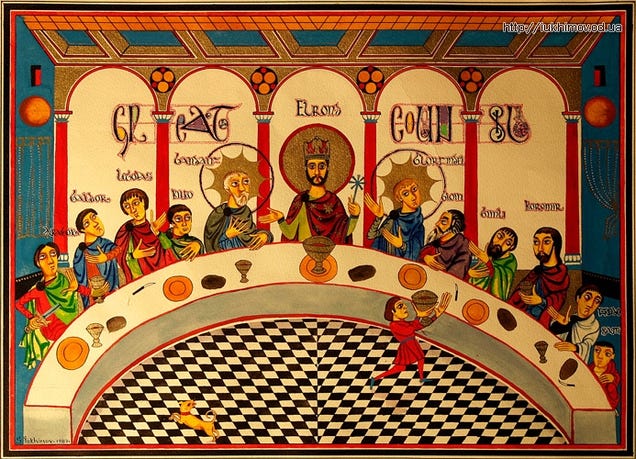
I came across this really neat article on Pinterest the other day and I immediately fell in love with the pictures. Ukrainian artist Sergei Iukhimov created these gorgeous illustrations of Tolkien's Lord of the Rings in the style of medieval art and Russian Iconography. You really should click through and look at them, they are stunning. However, this was the one that really jumped out at me. It is very clearly drawn in the style of the many many paintings of the Last Supper, and this struck me as rather odd. What does the Council of Elrond have to do with the Lord's Supper? If I was going to compare anything to the Lord's Supper in the books, it would probably be Lembas bread, which sustains the fellowship on their journey with just one bite. So last night as I lay in bed I started thinking through all of the things I knew about the Council of Elrond, looking for the connection. Rivendell is frequently referred to as the Last Homely House. That could be compared to the Church, which could likewise be viewed as the Last Homely House in this sinful world and where your strength and hope and faith are renewed. Was that it? Was that the connection? Or was the connection that at the Council many groups of people joined together to be one, similar to how all Christians are one with Christ in his supper?

And then it hit me. What is instituted at the Council? The Fellowship. The Fellowship, which in Greek is koinonia, just as commonly translated Communion. Aha!

Of course, it is possible that Iukhimov simply wanted to use imagery of the Last Supper in something, and this was the best option for a feast scene. But I'd like to believe that this was a very intentional move. Either way, I think it's a pretty cool connection and a pretty awesome picture.

Sunday, 10 August 2014

Everyday Life


Is there not glory enough in living the days given to us? You should know there is adventure in simply being among those we love and the things we love, and beauty, too. 
-Lloyd Alexander

Everyday life doesn't feel all that adventurous, but Taran is slowly teaching me differently. Always dreaming about faraway lands and desperately wishing myself back, I have trouble being content where I am. I think that one of the many reasons the Chronicles of Prydain hit home with me is that Taran comes to learn the same lessons that I have to learn and relearn. My heart yearns for adventure and heroism and beautiful new places, just like Taran did, but I often fail to see the beauty, adventure, and heroics around me. "Long ago I yearned to be a hero without knowing, in truth, what a hero was. Now, perhaps, I understand it a little better. A grower of turnips or a shaper of clay, a Commot farmer or a king--every man is a hero if he strives more for others than for himself alone. Once you told me that the seeking counts more than the finding. So, too, must the striving count more than the gain." Lately, everyday life for me looks like:

watching: The Paradise, Monuments Men, How to Write a Hit Pop Song 1&2, Doctor Who Series 7, The Young Girls of Rochefort, Guardians of the Galaxy
reading: The Foundling, The Once and Future King, The Maltese Falcon, sentences in Greek
eating: kolaches, chocolate sugar cookies, italian beef, lemon drop cookies, banana bread granola, peaches, sweet corn
admiring: this lady's lovely photos, the creative writing of my little brother and sister and her best friend, the Welsh language
listening: Bastille, Oscar Peterson Piano Jazz, Welsh/Celtic music, my ever expanding soundtrack playlist, Parachute, Higher Things hymns
anticipating: designing my dorm room, (hopefully) going to Camp this September (and if not September then January), Doctor Who Series 8, apple and cinnamon fall days, the first snowfall of the year 
procrastinating: composing music, practicing piano, scrapbooking, editing videos/photos, basically my whole list of things I wanted to do this summer
feeling: hungry, tired, adventurous, hot, completely unprepared for school
smiling: Taran, Eilonwy, Gurgi, Fflewddur, Doli, Gwydion, Rhun, Hen Wen, Smoit, Llonio. Also emails from friends, scones for breakfast, first autumn leaves falling, communicating by Pinterest pins, Big Family Stuff (and honestly every other routine of his)
missing: the lilting cadence of Italian, beautiful German houses, eating ice cream on the steps in the city square of Erfut, walking through castle ruins on mountainsides, the pine and lake and campfire-smoke smell of Camp Luther, my best friends' laughs (I think this list could go on forever)
wishing: I lived in Europe, school wasn't so imminent, our town had cobblestone streets, Sherlock and Merlin had more episodes, I had some Milka caramel

Sunday, 27 July 2014

The Best Books Truly Change Our Lives


"Books can truly change our lives: the lives of those who read them, the lives of those who write them. Readers and writers alike discover things they never knew about the world and about themselves."
 -Lloyd Alexander

All I know is, I haven't enjoyed a book as much as the Chronicles of Prydain in a long time. Even now, weeks after finishing them, I can't get them out of my mind. The characters are like long lost friends to me, and I stay up at night talking about them with my sister. The books are funny, honest, and beautiful and all I want to do is read them again and again. I've read lots of books over the past week, but none of them have come close to reaching the bar set by Lloyd Alexander. If you read nothing else this summer, I suggest you read these books. They might just change your life.

Wednesday, 25 June 2014

Rekindling an Old Flame


When I was little you would be hard pressed to find me without a book. I was constantly reading, to the point that the only thing I ever asked for on my birthday was books (usually Redwall books). I absolutely adored reading. I don't know what I would be now if I hadn't had such an endless appetite for stories.

Fast forward a few years to my now college-muddled brain. I just haven't been reading as much. It takes more brain power than college leaves me with. Sure, I read books for school (I am an English minor, after all) but I never got the same joy out of them that I remember getting when I was little. It used to be that I would be utterly absorbed in a story and would be unable to leave the book until it was finished. I devoured stories as fast as I could. But in college even the rare books I did enjoy didn't capture my attention the way they once could. Was it the amount of school work? Was it the lack of energy? Was it the books themselves? Really, I think it was a mixture of all of the above. But I never read anything for fun and I just turned to Netflix for my adventures in other lands.

Then summer break came and I decided I wanted to read again. I picked up Julia Child's My Life In France and while I enjoyed it, I still wasn't captivated by it. I'm still only a fourth of the way through and haven't picked it up in weeks. Whoops. But finally, right as I began to despair of ever experiencing reading the same way again, Tolkien's Beowulf arrived in the mail. I have always loved the story of Beowulf and couldn't wait to dig in. The story itself was wonderful and the commentary was very enlightening but it was still more scholarly than anything. Not exactly transport-you-to-another-world reading. Until I got to Sellic Spell.


Honestly I haven't read anything so enjoyable in a very long time. Sellic Spell is Tolkien's retelling of what Beowulf might have been like if the poet hadn't combined it with history. In other words, if he had left the myth the way it originally was. It's the story of Beewolf, the bear-man with the strength of thirty men, Handshoe, his friend with magical gloves, Ashwood, the bold man with a powerful spear, and Unfriend, the sinister traitor in their midst. It read like a fairy tale and I read the whole thing (admittedly not very long) in one sitting. I should have known that if anyone could rekindle my love for reading it would be Tolkien. When I finished Beowulf I found myself in desperate need of a new book and as soon as possible. Thankfully I had just the thing waiting for me on my shelf. I received the Chronicles of Prydain for my graduation from some wonderful friends who have a great taste in books. They had been telling me to read the series for a while and, well I already told you that I never got around to reading. Now was my chance. I picked up the first one (I had read it once before, two years ago) and finished it in two days. It was every bit as enjoyable as I had hoped. The characters are delightful, the descriptions are vividly beautiful and it's just short enough that I can finish it in no time (maybe I won't appreciate that at the end when I'll inevitably wish it could go on forever).

Now, all I can think about is all the books on my summer reading list and how eagerly I want to read them. Since I've been on a King Arthur kick ever since Merlin, the next books on my list are the Dark is Rising Sequence which is another series I started and never finished (boy, it's embarrassing to admit how little I could focus with college looming over my shoulder).

I guess all of this is to say, in a long drawn out way, that Tolkien's Beowulf has managed to break a two year spell that had me in it's grasp ever since college started, and has rekindled an old flame. Netflix, you're still a great companion, but boy have I missed my books.